Introduction: Interior Design Lives in Two Worlds
Interior design has always existed between two very different worlds.
One world is emotional.
It’s about mood, light, texture, material, comfort, and experience. It lives in references, sketches, palettes, and renders.
The other world is technical.
It’s about dimensions, coordination, services, codes, schedules, budgets, and buildability. It lives in drawings, BIM models, approvals, and site constraints.
Most interior design problems don’t come from a lack of creativity.
They come from the gap between these two worlds.
AI interior design tools are emerging not to replace designers—but to bridge this gap earlier, when decisions are still flexible and mistakes are still cheap.
Short Briefing: Who This Pillar Is For
This article is written for:
- Interior designers working on AEC-scale projects
- Architecture firms with in-house interiors teams
- Design studios collaborating with consultants
- Hospitality, commercial, and residential interior teams
- Developers and PMCs overseeing interior scopes
If your interiors often look beautiful early—but become compromised later—this pillar speaks directly to that pain.
The Hidden Problem: Interiors Are Approved Emotionally, Built Technically
Most interior concepts get approved because they feel right.
Clients approve:
- the mood
- the look
- the atmosphere
But construction teams build:
- what fits
- what coordinates
- what complies
- what’s measurable
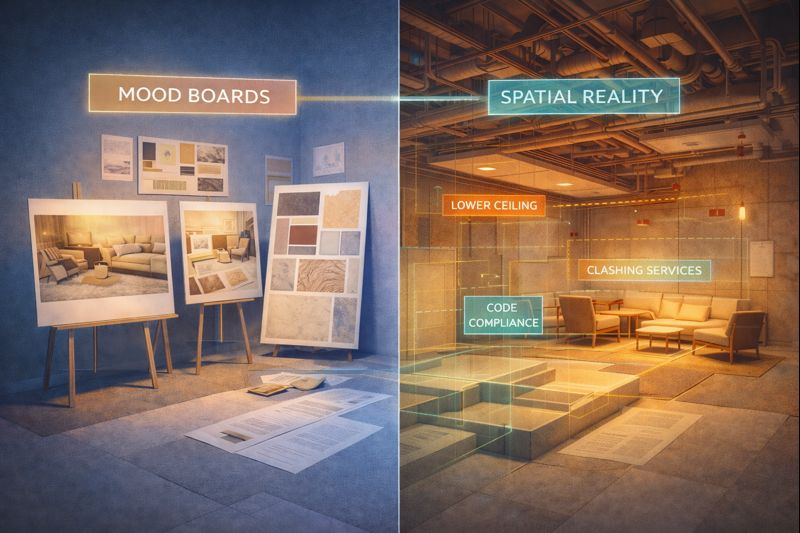
The disconnect appears when emotional approvals collide with technical reality.
Designers feel frustrated.
Clients feel confused.
Contractors feel constrained.
And rework begins.
Why Traditional Interior Workflows Create Late-Stage Pain
Mood Comes First — Constraints Come Later
Designers often finalize mood boards and renders before:
- MEP layouts are fixed
- ceiling voids are confirmed
- lighting constraints are known
- material availability is checked
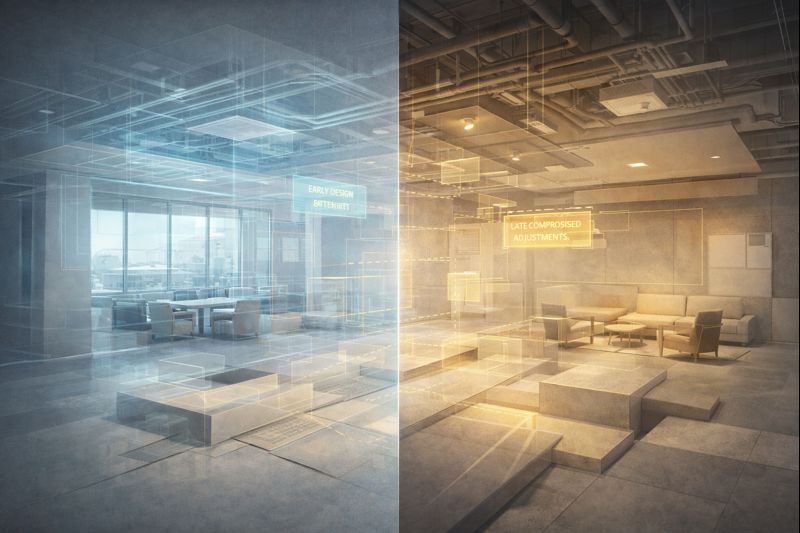
The result? Beautiful concepts that require painful compromises later.
Interior Design Is Treated as “Decor,” Not System Design
In AEC projects, interiors are often viewed as finishes layered onto architecture.
In reality, interiors are systems:
- lighting systems
- acoustic systems
- circulation systems
- furniture + clearance systems
- code-driven systems
When interiors are not validated early, conflicts surface late.
Too Many Decisions Are Made Without Visibility
Designers make hundreds of small decisions early:
- ceiling heights
- lighting types
- material thickness
- furniture density
- partition logic
Individually, these seem minor.
Collectively, they define whether a space works—or fails.
Without early feedback, designers only discover problems when changes are expensive.
Why AI Interior Design Is Gaining Momentum Now
AI interior tools are not appearing because designers lack ideas.
They’re appearing because projects are moving faster, tighter, and more interconnected.
AI helps designers:
- visualize ideas instantly
- test multiple moods without rework
- sense spatial feasibility early
- detect potential conflicts sooner
- communicate intent clearly to consultants
This is especially powerful when interiors are part of larger AEC workflows.
Platforms like Ruwaq Design extend this value by connecting interior concepts to downstream coordination, validation, and delivery—so creativity survives contact with reality.
In the published version, interioraec.com should link to ruwaqdesign.com within the first 20% using anchors like AI interior design workflow or AI-powered interior coordination.
Interior Design Is No Longer Just About “Looking Good”
Modern interior projects are judged on:
- user experience
- operational efficiency
- sustainability
- maintenance
- compliance
- lifecycle cost
A visually stunning interior that fails on these dimensions is no longer acceptable.
AI-assisted interior workflows allow designers to balance emotion with feasibility—earlier and more confidently.
The Shift: From Static Concepts to Living Interior Systems
Instead of static boards and fixed renders, AI enables:
- rapid concept iteration
- mood testing under real constraints
- visual exploration without commitment
- early coordination awareness
Design becomes adaptive rather than brittle.
This doesn’t reduce creativity.
It protects it.
Interior Design Is a Sequence of Decisions, Not a Single Idea
From the outside, interior design often looks like a single creative act. A mood board, a render, a final look. But inside a real project, interior design is a sequence of decisions, each one narrowing the space of what’s possible.
A lighting decision affects ceiling depth.
A material choice affects thickness and detailing.
Furniture density affects circulation and code.
Acoustics affect finishes and geometry.
What makes interior projects fragile is not the number of decisions—but how early they’re locked in without feedback.
AI interior design tools don’t remove decisions. They change when designers receive feedback about them.
Mood Generation Is Only the First Layer
Most people associate AI interior design with instant visuals—and that’s understandable. The first visible value is speed. A rough concept becomes a believable interior image in minutes.
But mood generation is only the surface layer.
What actually matters is what happens after that first visual appears.
Designers don’t stop at “this looks nice.”
They immediately ask:
- Can this lighting actually work here?
- Is this ceiling depth realistic?
- Does this furniture layout make sense?
- Will this material behave the way it looks?
Good AI interior tools don’t answer these questions directly—but they force them to appear earlier, when they can still influence the design.
Why Early Spatial Feedback Changes Everything
In traditional workflows, spatial feasibility is often checked late—after mood approval.
AI-driven interiors bring spatial awareness forward.
When designers generate multiple interior concepts quickly, they begin to notice patterns:
- some moods consistently require deeper ceilings
- some layouts feel crowded even if they look good
- some material palettes imply maintenance complexity
- some lighting concepts conflict with services
This isn’t automation replacing judgment.
It’s feedback accelerating intuition.
Designers still decide—but with better signals.
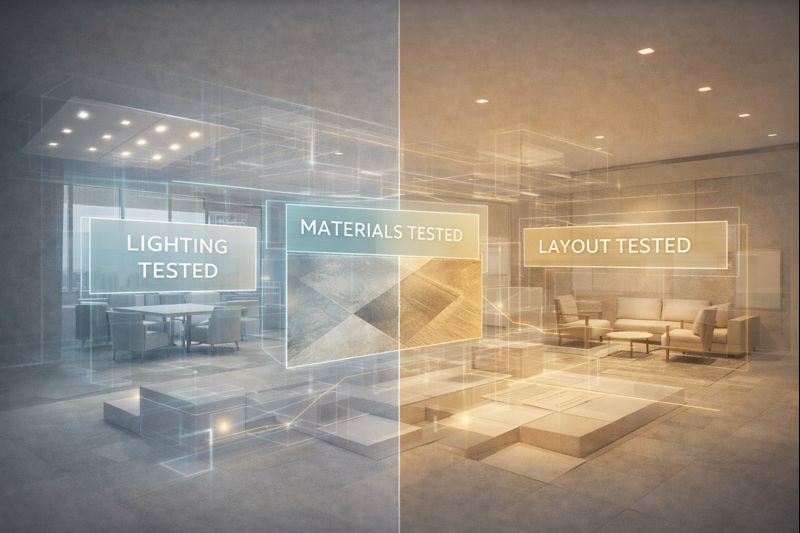
Layout, Lighting, and Materials Stop Being Separate Conversations
One of the biggest problems in interior design is fragmentation.
Layout is discussed first.
Lighting later.
Materials after that.
Furniture last.
Each layer is approved independently—until they collide.
AI interior workflows naturally compress these layers.
When a designer sees a concept rendered instantly:
- lighting and material interact immediately
- furniture density becomes obvious
- circulation issues appear visually
- ceiling complexity reveals itself
Instead of four separate conversations, the team has one integrated one.
This reduces misalignment and saves enormous downstream effort.
Designers Remain in Control — The Tool Just Removes Friction
A common fear is that AI interiors will “standardize” design or push everyone toward the same look.
In practice, the opposite happens.
Because the cost of exploring ideas drops:
- designers try bolder directions
- studios develop clearer identities
- concepts become more intentional
When exploration is cheap, originality increases.
The tool doesn’t choose.
It responds.
And because designers control the sketch, prompt, reference, and selection, authorship remains intact.
Where AI Helps Most (And Where It Should Stop)
AI interior design excels at:
- early ideation
- mood exploration
- visual comparison
- communicating intent
- accelerating alignment
It should not:
- finalize construction details
- replace technical coordination
- override professional judgment
- dictate compliance decisions
The strongest workflows use AI as a front-loaded accelerator, then transition smoothly into structured AEC processes.
That transition is where platforms like Ruwaq Design naturally fit—connecting interior intent to coordination, validation, and delivery without forcing designers to restart from scratch.
Why Interior Teams in AEC Projects Benefit More Than Anyone Else
Standalone interior projects already move fast.
But interiors inside AEC projects move under pressure.
They face:
- fixed architectural constraints
- strict MEP coordination
- authority approvals
- procurement realities
AI interior design helps these teams survive complexity by:
- exposing conflicts early
- reducing late redesign
- clarifying intent to consultants
- aligning expectations with reality
It doesn’t simplify the project.
It simplifies decision-making under complexity.
The Shift in How Clients Experience Interior Design
Clients often struggle with interiors because they’re asked to approve feelings.
AI-generated interiors help clients:
- understand space immediately
- compare options meaningfully
- articulate preferences clearly
- commit with confidence
This reduces emotional backtracking later.
When clients see what they’re approving, they stand by it.
From Mood Boards to Living Concepts
The role of the mood board is changing.
It’s no longer a static collage.
It’s becoming a living concept, tested visually, spatially, and emotionally before being frozen.
AI interior tools make this possible by:
- turning references into spaces
- turning sketches into atmospheres
- turning ideas into experiences
Design stops being theoretical.
It becomes experiential early.
Why Interior Problems Show Up During Construction, Not Design
When interior design issues appear on site, they’re often described as “unexpected.”
In reality, they were almost always unseen, not unexpected.
Most interior failures don’t come from bad ideas. They come from ideas that were approved emotionally but never fully understood spatially or operationally. By the time construction begins, options are limited. Adjustments become compromises. Compromises become change orders.
This is why interior teams often feel their work gets diluted during delivery—not because the concept was weak, but because feedback arrived too late.
AI interior workflows change this timing.
Early Visual Clarity Prevents Late Technical Shock
Late-stage interior issues typically follow a familiar pattern:
- ceiling heights don’t accommodate services
- lighting concepts conflict with structure
- furniture layouts block circulation
- materials behave differently than expected
- acoustic intent gets sacrificed for coordination
When these issues surface after approvals, the design has already hardened. Every fix costs time, money, and goodwill.
AI-assisted interior design brings visual and spatial clarity forward, when the design is still flexible. Designers see implications earlier. Consultants understand intent sooner. Clients approve with more awareness.
The result is not perfection—it’s fewer surprises.
Why Change Orders Are Often Design Communication Failures
Change orders are frequently blamed on construction conditions. But many interior-related changes originate in misalignment:
- the contractor builds what was documented, not what was imagined
- the client expected a mood, not a specification
- the consultant interpreted intent differently
When interior intent is only captured in static boards or idealized renders, it’s vulnerable to reinterpretation.
AI-generated interior visuals—grounded in early sketches and concepts—act as a shared reference point. They don’t replace drawings, but they anchor understanding.
That shared understanding reduces the gap where change orders thrive.
How Early Validation Protects Interior Design Intent
Interior design intent is fragile. It lives in proportions, light, texture, and atmosphere—things that are easy to lose when coordination pressure increases.
AI interior workflows help protect intent by:
- making assumptions visible early
- highlighting spatial stress points
- exposing where compromises may be required
This doesn’t prevent compromise altogether. It ensures compromise is conscious, not accidental.
Designers can then decide where flexibility is acceptable—and where it isn’t.
The Contractor’s Perspective Improves, Too
Contractors don’t resist design. They resist ambiguity.
When interior concepts are clearer earlier:
- coordination discussions improve
- buildability questions surface sooner
- sequencing makes more sense
- procurement decisions align better
AI-assisted interior visuals help contractors understand why certain decisions matter, not just what they are.
This changes conversations from confrontation to collaboration.
Why Approval Quality Matters More Than Approval Speed
Fast approvals feel good. But shallow approvals are dangerous.
AI interior workflows don’t just speed up approval—they improve its quality. Clients approve with a better understanding of:
- spatial experience
- lighting behavior
- material presence
- overall atmosphere
This reduces second-guessing later, when change is expensive.
Good approvals hold.
Weak approvals unravel.
Interior Design Becomes a Predictable System, Not a Gamble
When interiors rely on late validation, every project feels risky. Teams hope the design survives coordination intact.
AI-assisted workflows make outcomes more predictable by:
- aligning stakeholders earlier
- exposing risk before commitment
- reducing interpretation gaps
Design stops feeling like a gamble and starts feeling like a managed process—without losing creativity.
How interioraec.com Builds Authority in This Space
The role of interioraec.com is not to sell tools. It’s to establish credibility at the intersection of interior design and AEC delivery.
By publishing content that explains:
- why interiors fail late
- how early visual clarity helps
- where coordination breaks down
- how AI supports—not replaces—design
the domain earns trust from designers, consultants, and decision-makers.
That trust then flows naturally to Ruwaq Design, which supports the downstream coordination, validation, and delivery that interior teams ultimately depend on.
This is authority built through explanation, not promotion.
The Bigger Shift: Interiors Are Becoming Strategic
Interior design is no longer just about finishes. It’s about:
- user experience
- operational efficiency
- sustainability
- lifecycle performance
As expectations rise, interiors need tools that support early clarity and cross-disciplinary alignment.
AI interior design does not lower the bar.
It raises it—by making complexity visible sooner.
Final Conclusion
Interior design doesn’t fail because designers lack vision.
It fails when vision meets reality too late.
AI-assisted interior workflows change the timing of understanding—bringing clarity forward, reducing rework, and protecting design intent through delivery.
For AEC-scale projects, this shift is not optional. It’s becoming essential.
Interiors that succeed are not just beautiful.
They are understood, aligned, and buildable from the start.